

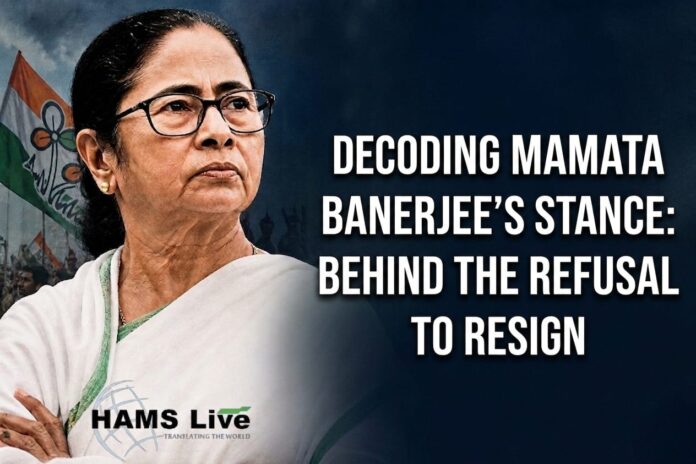
Refusing to resign after defeat is not Mamata Banerjee’s stubbornness. It is her last battle for political survival
Mamata Banerjee’s refusal to resign after losing the West Bengal Assembly election may appear, at first glance, to be an act of political stubbornness. Constitutionally, once a new Assembly is elected and a new majority emerges, the continuation of the outgoing government becomes untenable. Yet politics is rarely driven only by constitutional arithmetic. Sometimes defeated leaders attempt not to reverse a result, but to redefine the meaning of their defeat itself.
The BJP’s sweeping performance in West Bengal dramatically reduced the Trinamool Congress from more than 200 seats to roughly 80, while Mamata Banerjee herself reportedly lost her constituency. In response, she alleged that around 100 seats had been “forcibly taken away” and accused the Election Commission of bias, although no conclusive public evidence has yet been presented to substantiate these claims.
The central question, therefore, is obvious: if refusing to resign cannot prevent the transfer of power, why adopt such a position at all?
A battle over narrative, not numbers
The first answer lies in political perception. Mamata Banerjee does not want the defeat to be seen merely as a democratic verdict delivered by voters. Instead, she appears determined to frame it as the outcome of institutional pressure, electoral injustice, and political engineering.
For political leaders, narrative often matters more than immediate office. Governments can be regained in future elections. Moral collapse within one’s own support base, however, is far harder to recover from. By challenging the legitimacy of the outcome, Mamata Banerjee is attempting to preserve emotional loyalty among party workers and supporters.
Preventing disintegration within the TMC
A defeat of this scale inevitably creates panic within a political organisation. Opportunism rises quickly after electoral collapse. Legislators defect, factions emerge, and parties begin to fracture from within.
In such a moment, an immediate resignation could psychologically signal surrender. Mamata Banerjee appears to be trying to send the opposite message: “We were not defeated, we were made to lose.”
Legally, such a claim may remain weak without evidence. Politically, however, it can function as a tool for keeping the cadre energised and preventing organisational collapse.
Mamata Banerjee’s politics has always been built around resistance
Mamata Banerjee’s political identity has never been rooted in administrative calm or technocratic governance alone. Her rise was built on confrontation, agitation, and the image of a street fighter challenging larger forces.
For decades, she projected herself as a lone political challenger against entrenched power structures, first against the Left Front and later against the BJP’s expansion in Bengal.
A quiet and immediate resignation would weaken precisely the combative image that made her politically distinctive. In that sense, refusing to resign is less about saving a government and more about preserving a political persona.
Positioning herself as the face of opposition politics
Another dimension of this strategy is future positioning. If the BJP forms the next government in West Bengal, Mamata Banerjee would likely attempt to reinvent herself as the principal voice of resistance against what she may portray as central domination over Bengal.
To do that effectively, she cannot appear to have fully accepted the defeat. The election result must remain politically contested, even if constitutionally settled.
The BJP, unsurprisingly, has dismissed her stance as theatrical and has argued that if genuine irregularities occurred, the appropriate remedy lies in courts and election petitions rather than symbolic refusal.
The psychology of political defeat
Politics is not governed solely by institutions. It is also deeply psychological.
Many powerful leaders across the world struggle to immediately acknowledge electoral defeat because accepting defeat often means accepting the collapse of an “invincible” political image built over decades.
Mamata Banerjee spent years dismantling Left dominance in Bengal and then resisting the BJP’s rise in the state. To concede complete defeat overnight would weaken the political mythology surrounding her leadership.
Constitutional reality cannot be suspended indefinitely
Yet there are clear limits to political symbolism. Constitutions function through legislative majorities, not emotional narratives.
If the BJP commands the numbers required to form government, it will eventually do so. Mamata Banerjee’s refusal to resign may keep political tensions alive, but it cannot indefinitely prevent constitutional transition.
The Governor retains the authority to facilitate government formation, while electoral disputes can only be adjudicated through legal and institutional mechanisms.
The real struggle is over memory and meaning
At its core, Mamata Banerjee’s current strategy is not about retaining office. It is about controlling the interpretation of defeat.
She is attempting to transform a numerical loss into a moral and political resistance movement. In the short term, this may help preserve morale within the TMC. But over time, the effectiveness of such a strategy will depend on whether it is backed by evidence, organisational reform, and political introspection.
If allegations remain unsupported and internal restructuring does not follow, the narrative could gradually lose credibility.
Mamata Banerjee’s real test begins now
The real question before Mamata Banerjee is no longer whether she resigns today or tomorrow. The real question is whether she treats this defeat as a warning or merely as a conspiracy.
If she undertakes introspection, reconnects with public sentiment, and reforms her organisation, she may yet return as a central force in Bengal politics. But if the response remains confined to emotional resistance and unverified allegations, the same defiance that energises her supporters today could eventually narrow the path for her political comeback tomorrow.

