

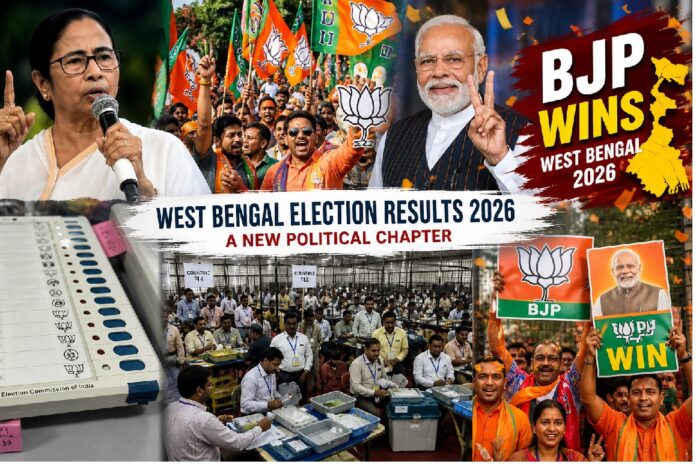
Anti-incumbency, governance issues, voter list controversies, opposition fragmentation, and strategic clarity from BJP all contributed to the shift
It is tempting to describe the 2026 West Bengal election as a dramatic upset. It is more accurate to see it as a slow erosion that finally became visible on counting day. Regimes do not usually fall in a single moment. They thin out, layer by layer, until one election simply reveals what has already been underway for years.
Mamata Banerjee’s defeat sits within that longer arc. The Trinamool Congress did not lose Bengal overnight. It gradually lost the moral ease with which it once spoke to its voters. That ease had been its greatest asset.
Analysts such as Yogendra Yadav described the exercise as more than administrative housekeeping, arguing that when millions of names come under question, the line between technical correction and political consequence begins to blur.
A contentious backdrop to this election was the revision of electoral rolls. Large-scale deletions and scrutiny of names created a debate that went far beyond procedure. Analysts such as Yogendra Yadav described the exercise as more than administrative housekeeping, arguing that when millions of names come under question, the line between technical correction and political consequence begins to blur. Whether one agrees with that assessment or not, it shaped perception. Elections are not only about numbers. They are also about what people believe has happened to those numbers.
Yet it would be simplistic to attribute the result to this factor alone. Anti-incumbency in Bengal had been maturing for some time. Fifteen years in power is long enough for even a popular leadership to begin facing the weight of accumulated expectations. Welfare schemes had reached wide sections of society, but welfare without visible structural transformation often plateaus. Jobs, local infrastructure, and institutional trust become sharper questions after the initial years of political enthusiasm fade.
What hurt the TMC more deeply was not its high politics but its ground reality. Across districts, complaints about localised power structures became a recurring theme. The so-called land syndicate culture, whether exaggerated in political rhetoric or rooted in lived experience, created the impression that everyday governance had shifted from institutions to intermediaries. When a citizen feels that access to basic services depends on proximity to party networks, frustration quietly replaces loyalty. Governments rarely collapse because of ideology. They weaken because of daily inconvenience.
At the same time, the opposition space did not consolidate in a straightforward manner. Instead, it fragmented. Smaller political actors and region-specific figures entered the field and sliced through vote banks that might otherwise have stayed intact. The presence of Asaduddin Owaisi, along with local players such as Humayun Kabir, did not necessarily produce large victories, but they altered margins. Indian elections are often decided not by who gains the most votes, but by who divides the other side more effectively.
In this shifting arithmetic, the role of the Indian National Congress becomes quietly significant. The Congress may not have dominated headlines, but its presence contributed to the fragmentation of the anti-BJP vote in several pockets. There is a certain irony here. The TMC itself once emerged by displacing Congress in Bengal. Now, a weakened Congress still retains enough residual influence to complicate TMC’s electoral calculations. Indian politics has a habit of circling back to its own unfinished stories.
This pattern is not unique to Bengal. The trajectory of the Aam Aadmi Party in Delhi offers a parallel. AAP rose by eroding Congress. Over time, the Bharatiya Janata Party positioned itself to challenge AAP with the same intent of replacement. Political formations in India rarely coexist indefinitely. They compete for the same social space, and eventually one attempts to absorb or eliminate the other. Bengal now reflects a similar churn.
For Muslim voters, who often find themselves discussed more as a category than as citizens, the election raises a different question. Political outcomes tend to generate cycles of fear and reassurance. But democratic participation cannot be built on fear. The more durable approach lies in remaining anchored to law, institutions, and civic engagement. Governments change. Citizenship does not. The strength of a community in a democracy is measured less by who is in power and more by how consistently it participates without panic.
Mamata Banerjee’s attempt to recalibrate her political messaging also deserves attention. In the run-up to the election, there was a visible effort to broaden appeal among Hindu voters through symbolic gestures and cultural outreach. Such moves were read by some as strategic balancing. But symbolism has limits. When governance concerns dominate voter consciousness, gestures struggle to override experience. Voters may acknowledge a message, but they vote on what they have lived through.
The Bharatiya Janata Party, on the other hand, approached the election with sharper narrative clarity. Its campaign blended the promise of change with identity-based consolidation and a sustained critique of the incumbent government. More importantly, it appeared organisationally disciplined. Elections are not won only through messaging. They are won through structure, coordination, and the ability to convert sentiment into turnout.
Internal fractures within the TMC further compounded its challenges. Leaders who once formed the backbone of the party crossed over, carrying with them not just voters but organisational insight. Such shifts are often underestimated. When a party loses insiders, it does not merely lose numbers. It loses memory.
For Muslim voters, who often find themselves discussed more as a category than as citizens, the election raises a different question. Political outcomes tend to generate cycles of fear and reassurance. But democratic participation cannot be built on fear. The more durable approach lies in remaining anchored to law, institutions, and civic engagement. Governments change. Citizenship does not. The strength of a community in a democracy is measured less by who is in power and more by how consistently it participates without panic.
There is also a broader lesson for the electorate at large. Political disappointment often leads to a sense of finality, as if one election has settled the future. History suggests otherwise. Bengal itself has moved from one dominant force to another over decades. What appears decisive in one moment often becomes transitional in the next. The political class operates within its own logic of competition and survival. Its alignments shift with time. For citizens, the task is not to attach permanence to any one formation, but to understand that change is built into the system.
If anything, the 2026 result underlines a more uncomfortable truth about contemporary elections. They are not always decided purely on governance merit. They are shaped by a combination of institutional processes, narrative control, organisational capacity, and the management of electoral mechanics. This does not diminish democracy, but it complicates it. It reminds us that the contest is no longer confined to policy. It extends to perception and process.
The fall of the TMC, therefore, should not be read as a simple victory of one party over another. It is the outcome of accumulated discontent, strategic recalibration by opponents, fragmentation within the opposition space, and a changing political landscape where no dominance is permanent. Bengal has entered another phase of its political journey. It will not be the last.
In the end, the most grounded way to view this election is to recognise that power circulates. Parties rise, consolidate, and eventually confront their own limits. What remains constant is the electorate, which continues to respond, recalibrate, and, when necessary, replace.

