

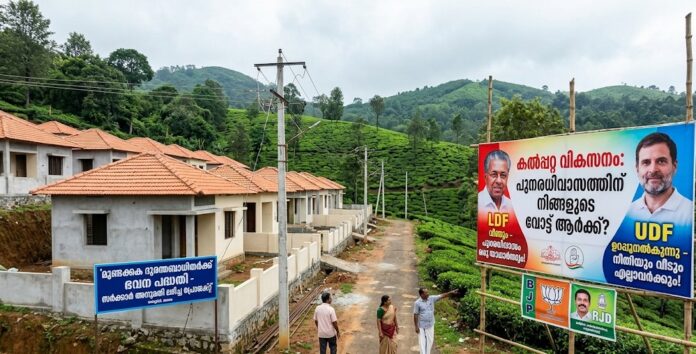
The high stakes of home: rehabilitation as a political battleground in Kalpetta
Standing in the heart of Wayanad, you can see two different versions of Kerala’s future. On one side of the road are rows of newly built, single-storey houses with bright terracotta roofs. They are meant to be symbols of hope for those who lost everything in the Mundakkai-Chooralmala landslides. But as you look closer, the “hope” feels unfinished. The roads are still dirt tracks, the power lines aren’t all connected, and the silence of an empty housing colony hangs heavy in the air.
Turn around, and the view is dominated by massive, towering billboards. These are the “battle flags” of the upcoming assembly elections. In Kalpetta, the election isn’t just about who sits in the legislative assembly; it has become a referendum on how a society heals after a tragedy. The recovery process, which should have been a unified human effort, has instead morphed into a fierce competition of political branding.
Concrete reality versus the polish of a campaign poster
The political divide is literally written on the walls. On one side, the ruling Left Democratic Front (LDF) has draped the area in posters claiming “rehabilitation is a reality.” They point to the 178 homes already built as proof of their competence. For them, every brick laid is a vote earned. They argue that while others talk, they have delivered.
Across the street, the United Democratic Front (UDF) offers a different narrative. Their posters don’t focus on what has been built, but on what is missing. They speak of “justice and homes for all,” implying that the current efforts are a mere facade—a “hastily arranged photo-op” that ignores the families still stuck in temporary shelters and the crumbling infrastructure of the new sites.
For the voter walking between these two worlds, the choice is exhausting. They aren’t looking at these posters to see which leader looks more prime-ministerial; they are looking to see who will actually finish the plumbing before the next monsoon hits.
Why the “human element” will decide the ballot
What makes this election so deeply personal is the sense of exclusion. Behind the statistics of “completed houses” are real people like Muthan and Jayanna, survivors who find themselves left off the official beneficiary lists despite losing their livelihood. For them, the loud slogans on the billboards feel like a cruel irony.
The local sentiment suggests a growing fatigue with “optics.” While the LDF banks on its image as a “builder” and the UDF leans on the star power of figures like Priyanka Gandhi to highlight government failures, the average resident is doing their own math. They are weighing the LDF’s “concrete progress” against the UDF’s “promise of better oversight.”
Ultimately, the Kalpetta election is a test of how we value accountability in a crisis. The billboards will eventually be torn down, and the campaign noise will fade. What will remain are the families sitting in those houses. The true winner won’t be the party that puts up the biggest poster, but the one that ensures the keys handed over to survivors actually open the doors to a functional, secure life. In Kalpetta, trust isn’t bought with a slogan—it’s built with a finished roof and a working tap.

