

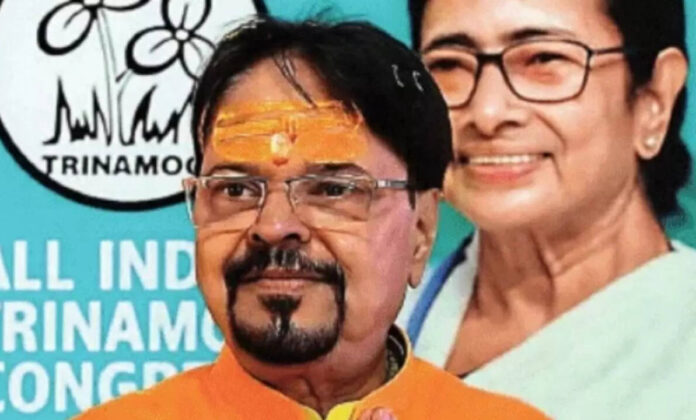
Trinamool Congress Selects Vijay Upadhyay to Challenge BJP’s Growing Influence in Kolkata’s Jorasanko
In an intriguing political maneuver ahead of the upcoming assembly elections, the Trinamool Congress (TMC) has announced the nomination of Vijay Upadhyay, a seasoned two-time councillor, as its candidate from Jorasanko. This decision comes as a strategic replacement for sitting MLA Vivek Gupta, amid rising competition from the Bharatiya Janata Party (BJP) within this vibrant trading hub of Kolkata. The elections are scheduled for April 29, marking an important moment for TMC as they seek to consolidate their hold on Jorasanko, a constituency that has historically leaned in their favor since 2011.
Vijay Upadhyay, considered a loyalist within TMC, is seen as a candidate capable of bridging various community divides. His deep religious roots and connections among different social strata are expected to play a crucial role in winning over voters in a constituency where identity, commerce, and local networks significantly influence electoral outcomes. “I am a deeply religious person, but not an extremist,” Upadhyay stated, highlighting his intent to foster unity in a region where demographic diversity often complicates political alliances.
The constituency of Jorasanko, which has seen significant voter deletions in recent electoral exercises, is not just a local battleground but a microcosm of larger political trends in West Bengal. As the TMC prepares for a fierce contest against the BJP, strategists within the party are banking on Upadhyay’s extensive local knowledge and moderate public perception to counteract the BJP’s rising acceptance among the business community and Hindi-speaking voters. Upadhyay, who has been associated with the TMC since 2010, previously participated in the pivotal Singur and Nandigram movements while representing the Samajwadi Party.
Vijay Upadhyay’s nomination reflects an astute recognition of the challenges that the TMC faces in Jorasanko. The BJP’s steady gains, particularly among the business community, have prompted the TMC to rethink its candidate strategy. Upadhyay’s candidacy, with roots in the community and an emphasis on inclusive governance, is perceived as a tactical effort to stabilize TMC’s support base. Notably, nearly four of the 11 wards in Jorasanko have a significant Muslim population, a demographic that the TMC hopes to engage effectively under Upadhyay’s stewardship.
As the political landscape in West Bengal shifts, TMC’s leaders express confidence in their decision. “BJP has no issue except Hindutva,” Upadhyay argued, suggesting that the opposition’s strategy focuses on religious identity rather than substantive community issues. He envisions his campaign as one that will work to “act as a bridge between communities in Jorasanko,” addressing the needs and fears of voters amid concerns about security and community relations.
The implications of this candidate choice stretch beyond the mere election result in Jorasanko. The political weight of the constituency has amplified with the SIR 2026 developments, where a notable portion of the local electorate faced disenfranchisement. Upadhyay dismissed concerns surrounding voter deletions, arguing that any attempts to intimidate voters would backfire and strengthen TMC’s resolve. “People can do business without any fear,” he asserted, reassuring constituents of a stable and secure environment conducive to trade.
Intriguingly, Upadhyay’s nomination has garnered attention even among opposition ranks. A local BJP leader acknowledged TMC’s strategic positioning, remarking that “Trinamool has sprung a surprise” by selecting a familiar and respected local figure. This indicates a recognition of Upadhyay’s potential appeal, which may complicate BJP’s electoral strategy against him.
As the election approaches, the BJP is yet to announce its candidate for Jorasanko, leaving room for speculation on how they will respond to TMC’s calculated move. Upadhyay’s supporters believe that his longstanding relationship with the local electorate, combined with his religious but moderate public image, may mitigate BJP’s appeal among segments of the trader and Hindi-speaking vote. “This time, Trinamool will register its biggest win in Jorasanko,” Upadhyay confidently declared, underscoring the high stakes involved in the upcoming electoral battle.
Navigating the Complex Political Landscape of Jorasanko
The announcement of Vijay Upadhyay as the TMC’s candidate for Jorasanko underscores the shifting dynamics of political allegiance in Kolkata. As the BJP continues to challenge TMC, the long-standing dominant force in the region, the choices made by party leaders will significantly affect voter sentiment leading up to the elections.
With India’s political environment becoming increasingly polarized, candidates like Upadhyay, who emphasize unity and community engagement, could play a pivotal role in shaping voter perceptions. His emphasis on acting as a unifying figure rather than adhering strictly to communal lines may resonate well with constituents who prioritize cooperative governance over divisive rhetoric.
The strategic significance of Jorasanko cannot be overstated, especially as political parties recalibrate their approaches amidst changing demographics and voting patterns. Leaders from the TMC are acutely aware of the need to maintain a coalition that encompasses various community interests, particularly in a constituency where history and identity are intertwined with contemporary political aspirations.
In the days leading up to the election, the pressure will mount on both TMC and BJP to clearly define their narratives and appeal to voters. Upadhyay’s candidacy may prove to be a critical element in TMC’s strategy to retain its foothold in Jorasanko. Observers will be keenly watching how both parties navigate the complexities of community relations and voter engagement in a region poised for significant electoral change.
Broader Implications for West Bengal’s Political Future
The candidacy of Vijay Upadhyay in Jorasanko may symbolize more than just a strategic electoral decision for the TMC; it could also reflect broader trends within West Bengal’s political landscape as parties adapt to shifting demographic and ideological currents. As the TMC seeks to reinforce its position against an increasingly organized BJP, the outcomes of this election will likely shape the trajectory of political affiliations and governance in the state for years to come.
Moreover, as voters respond to candidates who promote inclusivity over sectarianism, the election could either bolster communal harmony or exacerbate existing divides—elements that will require careful handling from party leaders post-election. With the region’s commercial interests at stake and the evolving relationship between different community groups, the political climate in West Bengal remains uncertain, underscoring the importance of strategic candidate selections like that of Vijay Upadhyay.
As the election date approaches, the political landscape in Jorasanko may reveal much about the future of state politics, the viability of traditional parties, and the potential for new alliances formed in response to voter priorities. Investments in community engagement and a focus on unity may very well determine the fate of parties as they navigate this pivotal electoral horizon.

