
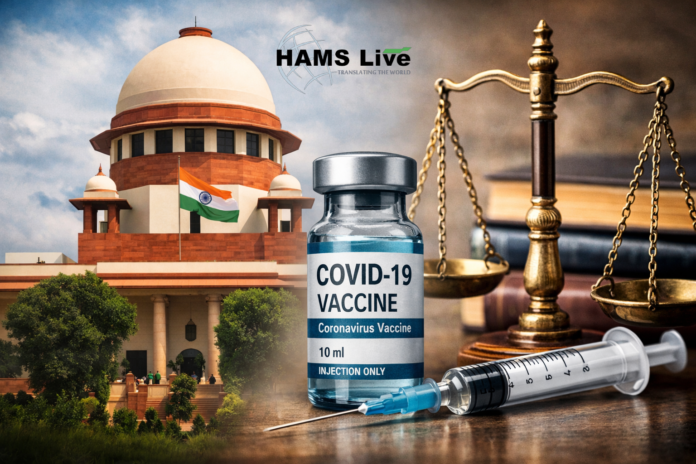
Supreme Court directs Centre to frame compensation policy for deaths and injuries caused by COVID-19 vaccine side effects
The Supreme Court of India has directed the central government to formulate a compensation policy for deaths or serious injuries caused by coronavirus vaccine side effects, marking an important development in the country’s public health and legal framework.
The order came while disposing of a petition that sought compensation for families whose relatives allegedly died due to adverse reactions after receiving the COVID-19 vaccine. The matter was heard by a bench comprising Justice Vikram Nath and Justice Sandeep Mehta, who issued several key directions to the government regarding transparency and monitoring of vaccine-related side effects.
Supreme Court directs government to frame compensation policy
During the hearing, the Supreme Court instructed the central government to develop a structured compensation policy for cases in which individuals suffer death or serious harm due to adverse effects following COVID-19 vaccination.
The petition had demanded that families of victims who died after vaccination should receive financial compensation. It also requested the court to order a nationwide investigation into deaths that occurred after vaccination.
While disposing of the plea, the court agreed that the issue required attention and directed the government to prepare a policy framework addressing compensation for vaccine-related adverse events.
No separate expert panel for vaccine side effects
The court, however, declined the request to constitute a separate expert committee to investigate vaccine side effects. Instead, it stated that the existing monitoring mechanisms for vaccine safety would continue to function.
According to the bench, the current system that tracks adverse events following immunisation is already in place and capable of addressing safety concerns.
At the same time, the court emphasised that the government must regularly publish data related to vaccine side effects. This information should be made public periodically so that citizens and health experts can review the safety outcomes transparently.
Policy will not prevent people from approaching courts
The Supreme Court also clarified an important legal aspect of the proposed compensation policy.
It stated that formulating a compensation scheme does not prevent affected individuals from seeking legal remedies in court. The judges explained that the policy should not be interpreted as an admission of liability by the government or by any authority involved in vaccine administration.
Therefore, people who believe they have suffered harm will still retain the right to pursue legal action independently.
Background of the petition
The case was filed by the parents of two girls who allegedly died after experiencing side effects from COVID-19 vaccination. In their petition, they demanded a comprehensive inquiry into deaths that occurred following vaccination across the country.
They also asked for:
- An independent investigation committee
- Examination of post-mortem and autopsy reports of victims
- Financial compensation for the families of those who died
Although the Supreme Court did not order a nationwide probe, it recognised the seriousness of the issue and directed the government to create a policy addressing compensation.
Importance of the ruling
The ruling is being viewed as a significant step toward accountability and transparency in India’s vaccination programme. By directing the government to frame a compensation policy and publish data on vaccine side effects, the court has reinforced the need for public confidence in immunisation campaigns.
At the same time, the decision balances public health concerns with legal safeguards, ensuring that citizens retain their right to seek justice if they believe medical harm has occurred.
As India continues to evaluate the long-term outcomes of the COVID-19 vaccination drive, the government is now expected to draft and implement a compensation framework for vaccine-related adverse events, in line with the Supreme Court’s directions.

