

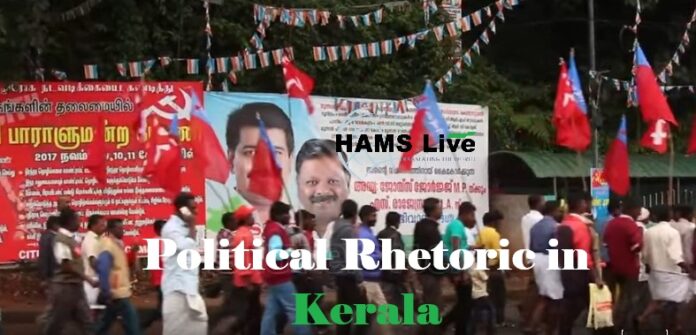
How politicians’ remarks shape the narrative in Kerala
The impact of derogatory language in Kerala’s election campaigns is more profound than ever, as social media ensures that slurs and insults persist well beyond their initial utterance. This trend not only distracts from pressing political discussions but also highlights the underlying misogyny that continues to permeate the state’s electoral landscape.
Unpacking the current political climate
In the lead-up to the recent elections, Kerala has witnessed a series of controversial statements made by political figures, escalating discussions around misogyny and the quality of political discourse in the region. Chief Minister Pinarayi Vijayan faced backlash for using the term “Chettatharam,” which carries connotations of meanness, while addressing former CPM leader G Sudhakaran during a televised interview. His subsequent clarification that the term was intended as a political characterization did little to quell the outrage.
Another example comes from Thomas Isaac, a member of the CPM’s central committee and a former minister, who also found himself under fire for comments made while campaigning. The latest uproar revolves around IUML leader Irshad, whose remark suggesting that LDF candidate U Prathibha of Kayamkulam was competing for votes by “selling her oratory skills and physical beauty” sparked immediate condemnation from various quarters.
Misogynistic remarks are not a new phenomenon in Kerala’s political history. A particularly notorious instance occurred during the 2011 Assembly elections when former Chief Minister V S Achuthanandan made disparaging comments about UDF candidate Lathika Subhash. These instances reveal a troubling trend: the persistence of derogatory remarks during election cycles and their longer-lasting implications for public perception.
The role of social media in amplifying controversies
Sociologist Jyothi S Nair highlights that while derogatory remarks are not exclusive to election periods, their longevity in the public sphere has been dramatically increased by social media. “Derogatory words and practices have always existed,” she explains, “but the scale at which such content spreads on social platforms is exponentially greater than in the real world.” As a result, these comments leave a lasting impression, overshadowing essential discussions about policies and governance that should ideally dominate electoral debates.
Nair points out that the “shelf life” of such remarks may be short, but the division they create among the public endures. The media’s focus on these incidents detracts from discussions on crucial issues like infrastructure, healthcare, and education—matters that impact the electorate far more directly than personal attacks.
Patriarchy and the lack of accountability
Bushara Begum, another sociologist, emphasizes the deeper issues tied to these remarks, linking them to the patriarchal structures embedded within society. “Misogynist remarks stem from the patriarchal elements of our society,” she states. “They persist because there are hardly any serious repercussions.” Despite complaints lodged with the Election Commission, meaningful outcomes are rare, leaving perpetrators to escape accountability.
This concerning trend raises questions about the effectiveness of public censure in deterring hate speech and derogatory comments. A consistent public response could play a significant role in holding political figures accountable. As the discourse continues to shift towards personal attacks rather than policy discussions, the electorate’s understanding of critical issues can become muddled, leading to disillusionment with the political process altogether.
Historical context: a pattern of neglect
The current political scenario in Kerala is not an anomaly; rather, it’s part of a longstanding pattern where misogyny and derogatory language have been tolerated or even normalized. The enduring nature of these slurs speaks to a culture that often prioritizes sensationalism over substantive dialogue. This historical context is critical for understanding why such remarks continue to resonate within the political sphere.
According to The Times of India report, the implications of these remarks are far-reaching. They not only perpetuate a culture of sexism but also hinder the progress of women in politics. With limited representation and a lack of seriousness given to addressing these issues, the cycle becomes self-perpetuating.
As social media becomes an increasingly pivotal force in shaping public opinion, the consequences for candidates—both positive and negative—are magnified. Leader’s words can quickly become instruments for ridicule or admiration, affecting their campaigns in real-time.
Navigating the political landscape
As Kerala continues to grapple with these issues, it becomes imperative for political leaders and parties to take a stand against misogynistic remarks and to prioritize respectful discourse. Addressing these challenges may require a cultural shift that acknowledges the role of language in undermining democratic processes and social unity.
Incorporating more women into political discussions and decision-making roles could serve as an antidote to the prevailing misogyny. Diverse representation can lead to a richer dialogue and a more inclusive political atmosphere, wherein slurs are not just challenged but rendered obsolete.
Moreover, civil society and the electorate must hold politicians accountable for their words. Public pressure can be a powerful tool in transforming the political landscape, ensuring that important topics are prioritized and that harmful rhetoric has no place in public discourse.
What this means going forward
The events unfolding in Kerala’s political arena illuminate a critical juncture for the state’s electorate. As social media amplifies the effects of derogatory language, it simultaneously offers a platform for collective action and accountability. Political candidates and parties must recognize the consequences of their words and strive to engage in a manner that elevates the dialogue rather than diminishes it.
Ultimately, it is within the power of the public—voters, activists, and concerned citizens—to demand a higher standard from their leaders. By focusing on policies, development, and a respectful exchange of ideas, Kerala can take significant strides towards a more equitable and forward-thinking political climate. The dialogue must evolve if the goal is to create an environment where merit, integrity, and mutual respect govern elections and govern our leaders’ interactions with the electorate.
Moving forward, the political landscape in Kerala’s elections demands not just candidates who can debate policies but leaders who can communicate with dignity and respect for all constituents, ensuring that the focus remains on what truly matters: the future of the state and its people.

