

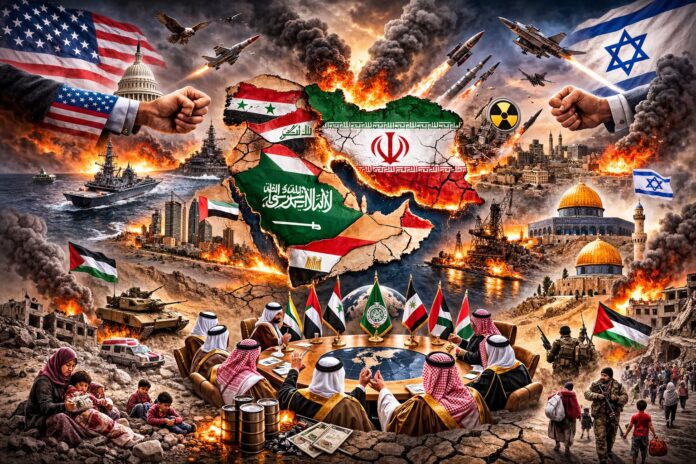
Growing Regional Tensions and Geopolitical Rivalries Put Arab Unity and Stability at a Critical Crossroads
The Middle East stands once again at a perilous turning point. Tensions involving Iran, Israel and the United States are rising in a manner that suggests more than routine diplomatic friction. Military calculations are being sharpened. Security doctrines are being revisited. Political rhetoric is becoming more direct. The central issue is not about supporting one side or opposing another. The deeper concern is whether a region already fractured by conflict can withstand another large-scale war.
The strategic relationship between Israel and the United States is not temporary or transactional. It is rooted in decades of security cooperation, intelligence sharing and political alignment. Washington has long viewed the Middle East through the lens of energy security, maritime stability and the containment of hostile or rival powers. Israel, for its part, frames national survival as a non-negotiable principle. Any development it interprets as an existential threat invites preemptive thinking within its security establishment. Iran’s nuclear program, its expanding missile capabilities and its network of regional allies are therefore seen in Tel Aviv as structural dangers rather than tactical irritants.
Iran presents a different narrative. Since the 1979 revolution, Tehran has defined itself as a state resistant to Western pressure and determined to assert regional influence. Years of sanctions, isolation and cyclical negotiations over its nuclear activities have shaped a political culture that is defensive yet assertive. Rather than engaging in direct and sustained confrontation with superior conventional military forces, Iran has often relied on layered deterrence. This includes regional partnerships, non-state actors and asymmetric capabilities designed to complicate any external attack.
This layered rivalry extends far beyond the borders of any single state. Lebanon remains sensitive due to the presence of Hezbollah. Gaza is perpetually volatile. Yemen has become a prolonged humanitarian and strategic crisis. Iraq and Syria continue to navigate fragile post-conflict realities. Any direct strike on Iranian territory or a full-scale Israeli-Iranian confrontation would not remain geographically contained. It could activate multiple fronts simultaneously. Shipping lanes in the Gulf could be disrupted. Oil production facilities could be targeted. Energy prices could surge across global markets within days.
Saudi Arabia and the United Arab Emirates stand at a delicate crossroads. Both states have experienced phases of confrontation and cautious engagement with Iran. Both are also pursuing ambitious economic diversification strategies that depend on stability, investment confidence and uninterrupted trade. A major regional war would threaten these long-term national visions. While neither country seeks open conflict, neither can easily remain untouched if escalation expands across the Gulf.
Qatar and Oman have historically played quiet but significant mediating roles. Their diplomatic channels have often remained open when others were closed. Backchannel negotiations, prisoner exchanges and exploratory nuclear talks have benefited from such mediation in the past. If tensions escalate further, similar diplomatic bridges may become essential to prevent irreversible breakdown.
The global context adds further complexity. The war in Ukraine has altered power alignments and intensified great power competition. China and Russia have expanded their diplomatic and economic presence in the Middle East. Any direct confrontation involving Iran could therefore intersect with broader geopolitical rivalries. Financial markets, supply chains and energy flows are already fragile. A new conflict would deepen global uncertainty and could trigger cascading economic consequences far beyond the region.
The humanitarian dimension is perhaps the most alarming. Syria has endured over a decade of devastation. Yemen continues to face one of the world’s worst humanitarian crises. Iraq is still rebuilding its institutions. Gaza remains in a cycle of destruction and reconstruction. Another war layered onto these unresolved crises would produce displacement on a massive scale. Infrastructure that barely functions could collapse entirely. Generational trauma would deepen.
Calls for Arab unity are not new, yet this moment gives them renewed urgency. The Arab world itself is not monolithic. The Gulf Cooperation Council has internal political dynamics. Egypt is managing significant economic pressure. Jordan operates within tight fiscal and geopolitical constraints. Iraq balances competing internal and external influences. Syria’s gradual reintegration into regional diplomacy remains tentative. Achieving a coordinated and unified response is politically complex. Yet fragmentation may carry even greater risks.
Historically, collective economic and diplomatic positioning has had measurable impact. Oil policy decisions and coordinated statements have influenced global markets and political calculations in the past. If major Arab capitals articulate a clear and consistent message that they will not allow their territories to become battlefields in a broader war, that signal could shape external strategic thinking. Silence, by contrast, may invite decisions taken without regional consent.
Within the United States there is also debate. Public opinion, congressional oversight and policy think tanks continue to assess the long-term costs of military interventions in the Middle East. The legacy of Iraq and the experience in Afghanistan remain cautionary references. A new war would not be politically neutral within American domestic politics.
Israel too faces internal pressures. Political divisions, legal controversies and persistent security threats on multiple fronts create a complex environment for decision making. Military action of significant scale carries not only external consequences but also domestic political implications.
Iran is equally constrained. Sanctions have strained its economy. A youthful population faces economic uncertainty and limited opportunities. Full-scale war would amplify internal pressures. While resistance rhetoric may mobilize segments of society, sustained conflict would test economic resilience.
The most urgent need in this environment is strategic restraint. Military escalation is often easier to initiate than to control. Once multiple actors engage simultaneously, miscalculation becomes more likely. Diplomatic channels, even when strained, remain essential. Transparency measures, confidence-building steps and incremental de-escalation can prevent worst-case scenarios.
This is not a simplistic binary of support versus opposition. It is a broader question of regional survival. Large parts of the Middle East have already endured systemic breakdown. Another war risks converting fragile states into permanently destabilized zones.
The coming months may determine whether political leadership across the region chooses escalation or containment. The Middle East does not require another battlefield. It requires calibrated diplomacy, coordinated regional messaging and a collective commitment to avoid irreversible destruction. History demonstrates that wars in this region reshape borders, economies and identities. Preventing another cycle of devastation demands courage not only on the battlefield but in negotiation rooms, cabinet meetings and regional summits.

