

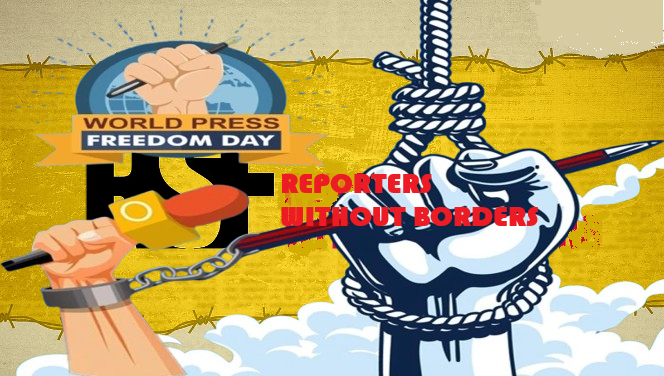


India’s Press Freedom Deteriorates as Media Compromises Independence
As the world observes World Press Freedom Day on May 3rd, the annual World Press Freedom Index published by Reporters Without Borders (RSF) reveals troubling trends in India. In the 2025 report, India finds itself languishing at a disheartening 151st position out of 180 countries, trailing behind nations like Nepal and Sudan. This alarming slide raises critical questions about the state of journalism in one of the world’s largest democracies.
The findings of the World Press Freedom Index hold considerable weight, particularly as they show that India is now ranked lower than several neighboring countries, such as Nepal (90th), Maldives (104th), Sri Lanka (139th), and Bangladesh (149th). While it still ranks higher than Bhutan (152nd), Pakistan (158th), Myanmar (169th), Afghanistan (175th), and China (178th), the overall decline underscores a grave situation in the media landscape.
The Changing Dynamics of Indian Media
In recent years, a cocktail of political pressure, financial dependency, and editorial compromise has significantly tarnished the Indian media landscape. Numerous television channels and digital news platforms have sacrificed their editorial independence, often opting to disseminate a singular narrative that aligns with the ruling government. Terms like “policy-aligned media” have emerged as euphemisms to critique this one-sided approach to reporting.
This worrying trend becomes especially apparent during critical events, such as the Pahalgam attack, where certain media outlets appear to act more like government spokespeople than impartial informants. The government even issued advisories urging the media to operate within its proper domain, a rare intervention that highlights the depth of the crisis.
Sensationalism Takes Precedence Over Substance
In an alarming development, certain television anchors have transformed meaningful debates into spectacles, prioritizing divisive issues that capture attention rather than inform the public. Topics such as employment, healthcare, and education have been sidelined in favor of sensational narratives surrounding religious tensions and border disputes. This not only undermines the credibility of journalism but also poses a threat to social harmony.
The indulgence in sensationalism can be understood as a desperate attempt to attract viewers and revenues in a financially vulnerable media landscape. As stated by RSF, “Media pluralism in India is under threat due to the concentration of media ownership in the hands of powerful political and corporate entities.” This concentration leads to a compromised media that favors sensationalism over serious journalism.
Global Organizations Raise Alarms
The Press Freedom Index evaluates countries based on five critical parameters—political, legal, social, economic, and safety-related concerns. The editorial director of RSF, Ann Bekenkamp, asserts, “There is no free press without economic independence.” The growing financial pressures faced by many media houses are forcing them to prioritize flashy reporting that garners attention rather than substantive journalism that holds power accountable.
According to the report, since Prime Minister Narendra Modi assumed office in 2014, Indian media has been functioning under what some describe as an “undeclared emergency.” Major media organizations with close ties to the government have substantially eroded the independence of journalism, creating a media environment that is increasingly fraught with challenges.
The Fundamental Role of Media in Society
The essential role of the media should be to serve as a watchdog and to raise public concerns—questioning authority and upholding the democratic values that underpin society. When journalism strays from this vital mission and becomes merely a mouthpiece for those in power, it risks losing its credibility, efficacy, and the trust of the public it aims to serve. Thus, a decrease in global rankings becomes not just a statistic but a reflection of a broader failure.
Despite these challenges, a minority of journalists and organizations remain committed to the principles of honest, balanced, and investigative reporting. Upholding such voices is imperative for the sustenance of a healthy democracy; they represent the potential for change amid a landscape marred by compromise.
In a time when media should act as a stabilizing influence—holding truth above state allegiances—it is essential for citizens to demand accountability and integrity from their news outlets. As per the report by Inquilab, the voice of the public must resound over the noise of sensationalism and state appeasement, ensuring that journalism returns to its core values.
By supporting independent journalism and fostering environments conducive to free expression, society can hope to reclaim the media’s role as a true representative of the people’s voice. Only through bolstering these values may India aspire once more to climb the ranks of the global media landscape.
For those seeking in-depth understanding of the challenges facing journalism today, consider exploring the implications of media ownership concentration and the current state of press freedom in India.
Upholding Journalistic Integrity for a Better Tomorrow
In a world where the integrity of journalism is increasingly at risk, it is imperative that we advocate for unbiased, truthful reporting that serves the public interest. The future of India’s media landscape depends on both journalists’ courage and the audience’s insistence on accountability and transparency. Only through collective efforts can we hope to restore the media’s rightful place as a pillar of democracy and the voice of the people.
(The author is the Resident Editor of Inquilab, Delhi)
📧 yameen@inquilab.com
Disclaimer:
The views, opinions, and analyses expressed in this article are solely those of the author and do not necessarily reflect the official stance of the organisation. The organisation is not responsible for endorsing or opposing any of the expressed viewpoints.